
Let’s finally get back to why we can’t just buy a captivating stock in an uptrend the moment we see it.
A stock that is in an uptrend does not keep moving up straight. Since the stocks we are looking for have few to no overhead supply, the only selling that can come in is profit-taking. And sooner or later, this will come in.
Extended stocks
As market participants, both private and institutional, who bought at lower prices keep seeing their profits grow, something happens. More and more speculators will have set price targets that are being reached and want to sell to take profits. Others will form an opinion that the stock has become “overvalued” and want to sell, and others will believe the stock is worth shorting being “so high in price”.
There are many reasons, but at some point, inevitably, there will be enough sellers accumulating that selling supply temporarily overcomes buying demand, and price will start to pull back significantly. A stock that moves up more and more in an uptrend without taking a breather is called an “extended” stock.

The more it is extended, the higher the risk of a significant pullback – the taller it stands after a significant advance, the more people are likely to start taking some profits. Once a stock starts declining somewhat, many other speculators will start seeing their profits shrink, and sell in anguish – amplifying the selling pressure.
Overall, a stock that is in an extended stage of a trend, is much more volatile, and it has a high potential for fluctuating quickly and widely (see graphic below). That is because accumulating selling for profit-taking by the existing holders of the stock will more and more start to outpace buying demand again. As a speculator, you’re job #1 is to cap losses while they’re small. That means if you were to buy at such a time point when the risk of many actors selling at the same time becomes higher and higher, the risk of you getting stopped out of a fresh buy rises astronomically.
Buying a stock that is at a point in time where it fluctuates strongly, and trying to manage risk at new buys, does not go well together. You might be right with your idea on the stock, but you are sure wrong on the timing. Odds are, you will get stopped out, whipsawed, on volatility and a pullback related to profit-taking. Speculators can rack up a large series of small losses when repeatedly trying to enter the volatility of an extended stock.
Of course, there is no calculation that gives you a clear probability of when this will happen; a stock might trend for quite a long while before selling comes in. It all depends on the type of holders and buyers, but a hard rule is that the further a stock is extended, the higher the likelihood becomes of experiencing volatility and stop-out induced losses right after you buy.
Price-swings/volatility from rising profit-taking make risk management impossible
To visualize this better, here is a chart of a stock that goes first side-ways and then starts a strong trend, i.e. becomes strongly bought by institutional money. Below is shown the price swings that the stock makes every day (%), and a red line is drawn where a 10%-stop loss would be triggered.
As you can see, after the trend has started and become interesting to a speculator, if he had bought the stock anywhere in the trend, he would have been stopped out immediately at many a time upon entering the stock.
Even if the % that a stock fluctuates daily is lower than the % of the stop-loss that you set, it only takes more 2 or 3 days of decline in a row and you’re stopped out as well.
While there may be select instances of days that would have worked, these are a) extremely rare, b) you can’t tell them in real-time and c) we’re looking for a statistically sound strategy that will work well in the long-term, rather than something that works as a one-off.

Await low-risk entry points
Since managing risk at all times is paramount and has priority over anything else, buying an extended stock may rarely work – but in the long run, you will lose money on such buys. Considering all this, you are better off awaiting a period in time where it is unlikely for you to get stopped out on random price moves. Towards this end, you need a point in time that fulfills two criteria:
- it has the highest chance of an uninterrupted continuation of the trend after you buy, and
- it has the lowest risk of you getting stopped out on a random price move beyond your stop loss.
Such a point is called a low-risk entry point, and it is found time and time again during the natural course of a trend.
Let us look at both criteria one by one.
Criterion 1 – Highest chance of trend continuation after buying
Criterion two for a low-risk entry point into a stock is to have on your side the highest chance of experiencing an uninterrupted continuation of the uptrend, right after you buy.
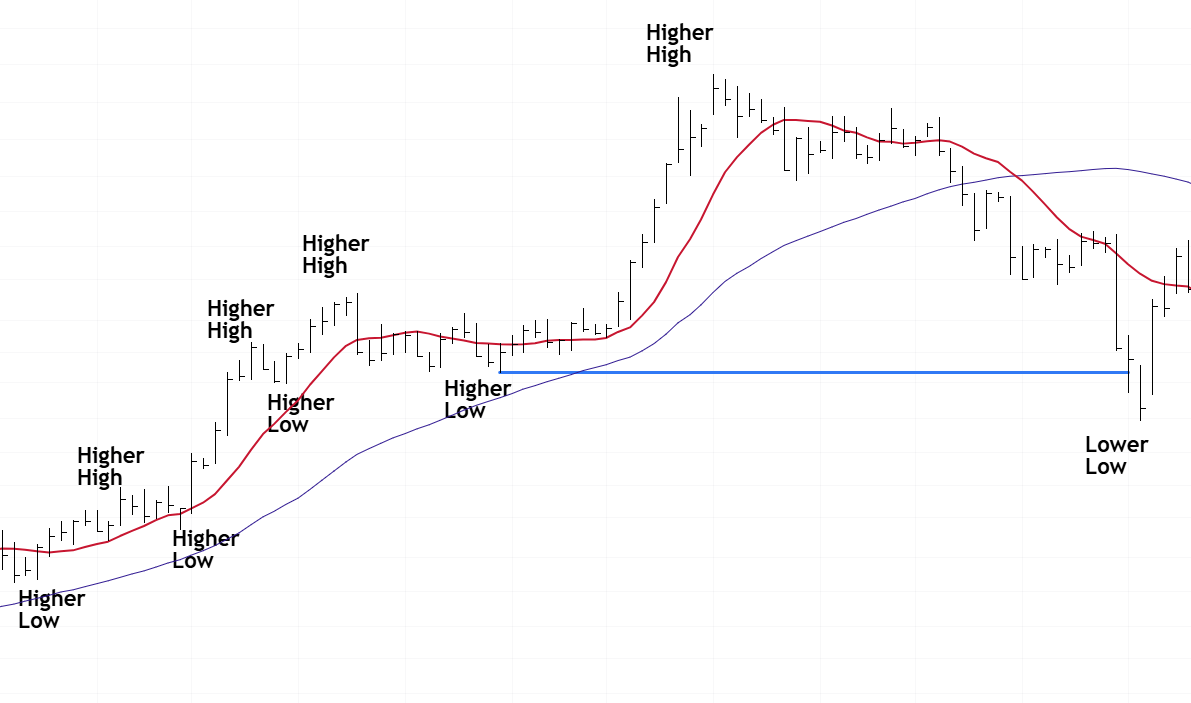
As seen in below schematics and exemplary chart, an up-trend is defined as a stock making a series of higher intermediate price Highs and higher Lows. The price declines after each successive price High is called a pullback. The opposite is true for a down-trend, marked by lower Lows, lower Highs, and rallies.
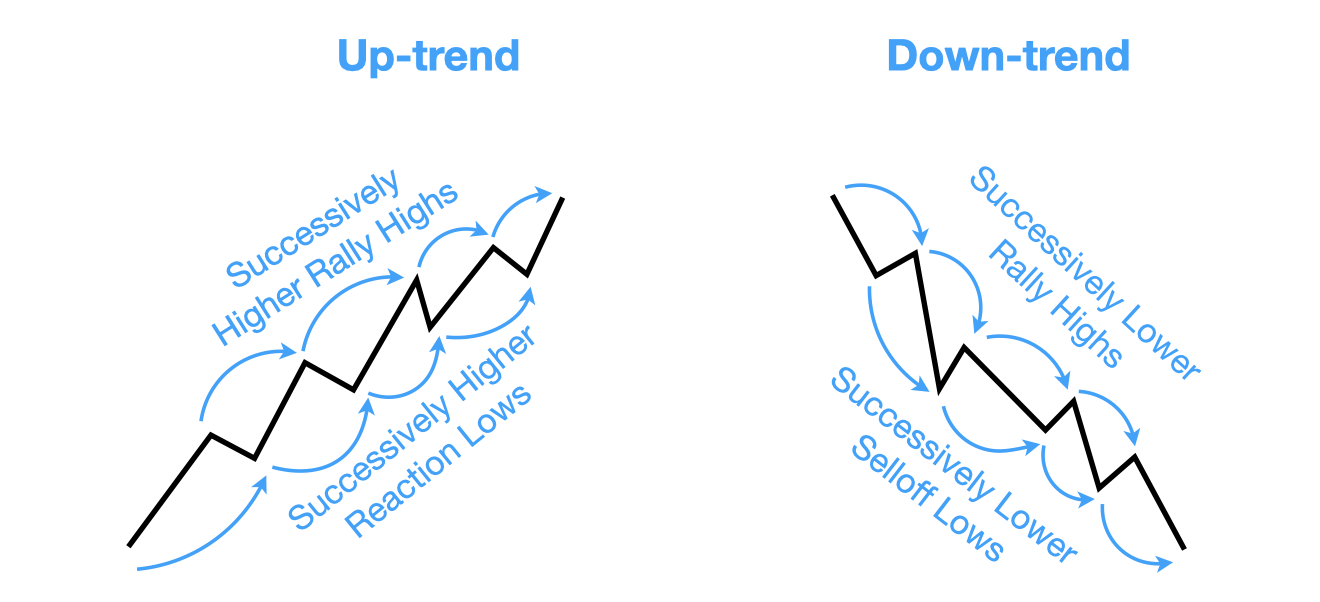
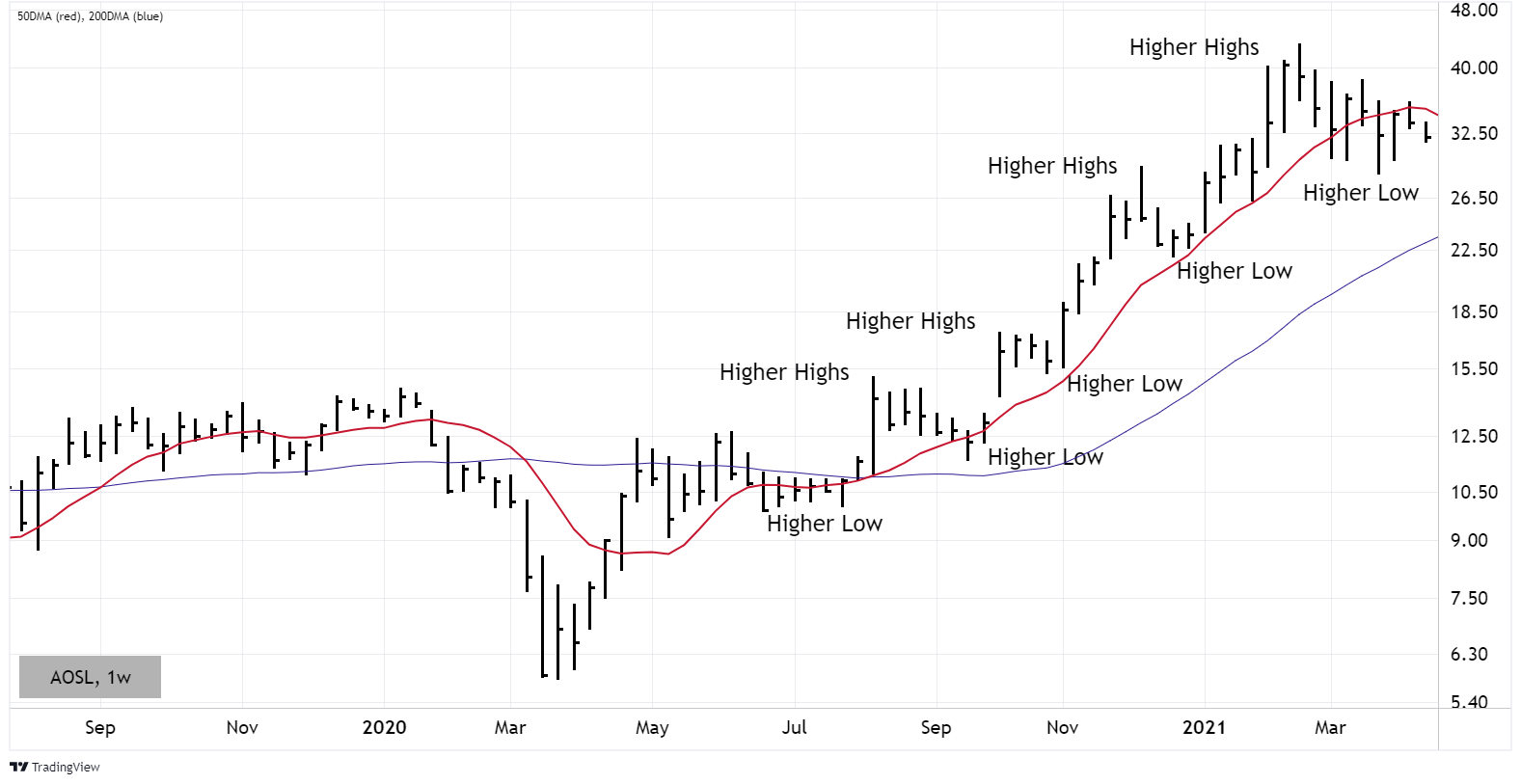
Pullbacks in price signify that the profits which the previous advance has produced for some earlier buyers need to be ‘digested’. This simply means that supply and demand need to balance out again before the uptrend can continue. Selling of the accumulating profit-taking selling and shorting the longer the trend gets extended is what causes this temporary downtrend in price and will stop any risk-managing speculator out if they buy at the wrong time.
Once supply has been absorbed by the buyers, and demand for the stock remains high, price will surpass the old High, to yet again make a new High. The point where price surpasses the old High meets the first criterion of our low-risk buy point – the trend is continuing by definition.
Criterion 2 – Not getting stopped out on random volatility
Remember, a speculator never goes in a stock without using stops, even if a trend looks strong – because she doesn’t know that the stock won’t reverse the moment she buys it, and and she doesn’t know whether this reversal is only a temporary break or the start of an 80% down-trend. Criterion one is embedded in this context of a speculator always needing to manage risk and use stops.
As we saw above, fixed-% stop-losses are not really a steadfast solution for having a logically-based protection of our trade. Let’s step away from the 10% stop (or really any fixed-% stop), and follow an alternative idea. A buy point and its combined stop loss need the lowest risk of stopping you out on random volatility or a volatile but normal pullback that is not associated with true collapse of a stock, causing you a loss immediately after you buy.
As we said, the more extended a stock is, the more the risk of a large wave of selling and volatility coming in rises. This selling from profit-taking is supply, and will temporarily outnumber buying demand when a pullback starts, leading to a somewhat significant pullback in price. Price will start to drop, some people who have bought the extended stock at higher prices will sell in fear, temporarily increasing the selling. But most that buy higher tend to hold their losing position, which will soon later result in some small overhead supply (see below). If the market is healthy, buying demand should come in again and support the stock not too far below. These are people who’ve been waiting for a pullback to buy, short sellers covering their positions, or ideally large institutions protecting their stock and supporting its price via large buy orders.
This buying should sooner or later bring price up again and across the old high price again, if the trend remains intact. For a trend to stay intact, higher Highs and higher Lows need to be sequentially recorded over time.
Applying this to our problem, we see that the price Low made in a given pullback is the real point, where – if price fell below it – the trend would temporarily or terminally end, most likely trading sideways for months or years without making higher Highs or lower Lows, or rolling over into the opposite of an up-trend, namely a down-trend (sequentially lower Lows and lower Highs).
Logically, the Lows of the most recent pullback are the point where, when placing a stop-loss below, would result in a speculator not getting stopped out on random volatility, but only on a genuine malign price move that invalidates the trend by definition – our second criterion for a low-risk buy point.
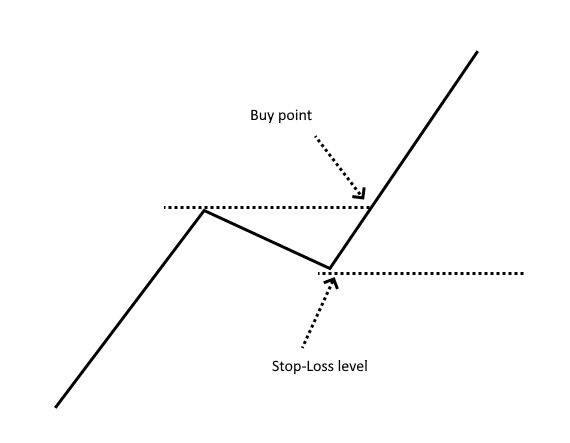
Putting the two criteria together, we can sketch the ideal buy point as price breaking into new Highs past a pullback, with our safety net of a stop loss being positioned below the pullback in order to protect against a trend that is reversing by its very definition:
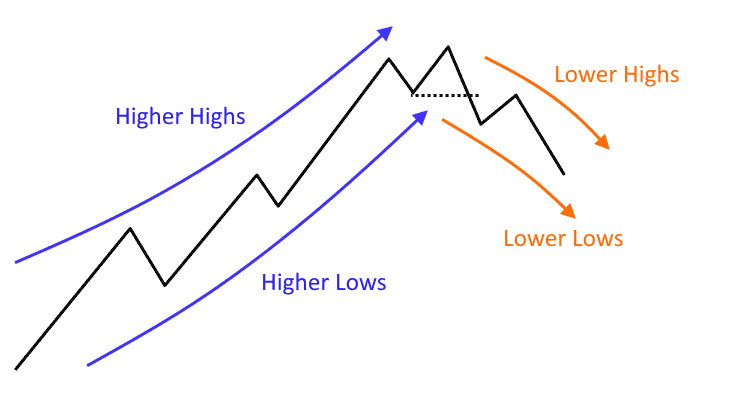
The latter – an up-trend being invalidated by a lower Low in price and turning into a downtrend, which we want to protect against – would appear as such schematic and exemplary weekly price chart:
So far so good for a basic understanding. This section was merely an introduction to trends, trend continuations and pullbacks for the bigger picture, which we will explore in detail later. For now, it’s only important to know that there are good times to buy a stock, and then there are all the other times.
Putting ideas together
When we can observe that buying demand drives stock prices above an old price High into new price High territory, the stock is demonstrating that the up-trend is most likely in the process of continuing, and has no overhead supply, which gives it the least chance of being interrupted in its advance right away.
Let’s put the two criteria for a low-risk entry point into a stock back together. We need to manage risk and cap losses when they’re minimal, that’s a given. So the best place for us, where we’re least likely to get stopped out on random whipsaws and shakeouts caused by volatility and selling, and where we’re most likely to observe and join the continuation of the trend of the stock, is when it actually continues the up-trend into new High price, our risk anchored via stop-loss to a point that would demonstrate a breakdown of this trend in the future. This would be the place to buy a stock with the lowest risk of losing and the highest risk of making money right away.