
Buy the issues that in a sense are hard to buy and easy to sell. I am talking about the action of shares in the early stages of a market or during a temporary recession in a clearly up market or just at the point when a market is emerging from a weak spell. The strength I speak of must just be noticeable to an experience trader.” – Gerald Loeb
“I tried to detect those stocks that resisted the decline. I reasoned that if they could swim against the stream, they were the ones that would advance most rapidly when the current changed in their direction.” – Nicolas Darvas
When markets are weak, or outright in decline and hostile, it pays to take a step back and look back at the basics. Uptrends are interspersed with shorter downtrends or corrections, downtrends are interspersed with limited rallies – and they will always be, as this is part of the definition of uptrends and downtrends.
In April 2025, the popular indices collapsed over 20% in a few short weeks and briefly dipped into bear market territory; a move that had been telegraphed weeks and months ahead by the leading stocks of the day (see here, here or here), and small- and microcap indices. As of this writing, popular indices the US have rallied above and beyond their 200-day moving averages (important psychological level for system trend followers), with the SP500 and the NASDAQ Composite a few percentage points back within the old all-time Highs.
While trying to assess whether there was a possible market bottom in a downtrend and how to act on it, the question arises whether it is possible to get an inkling what issues could become the stars of the next uptrend, the eventual headliners of the new bull market that everyone wants to be in (though typically too late). Even more so, could we tell what the some of the better performers will be, a little ahead of time?
Though there is no certainty in the stock market, some shrewd observations can typically point us in the right direction, if we’re willing to put in the work. Let’s look at a couple of auxiliary tools that might help us to do so.
The two ideas we’ll be discussing briefly are ‘relative strength’ and ‘resilience’.
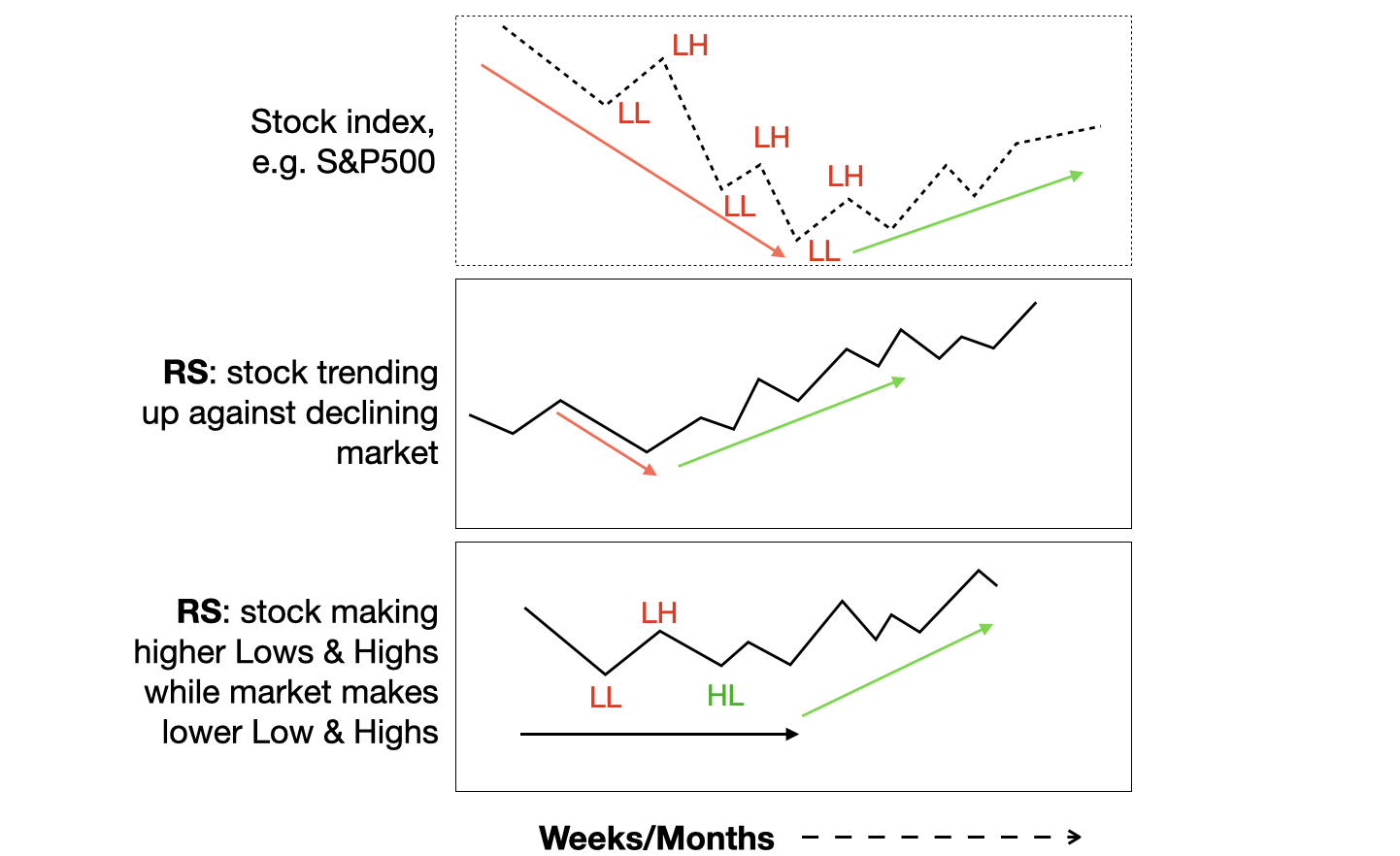
A stock shows relative strength (RS) when it declines less than a declining general market, not at all, or even advances. This reflects institutional accumulation masked by the overall negative market sentiment and volatility. The probability of the same stock attracting even more money when sentiment improves is high.
In other words, find the salmon swimming up the waterfall against the stream:
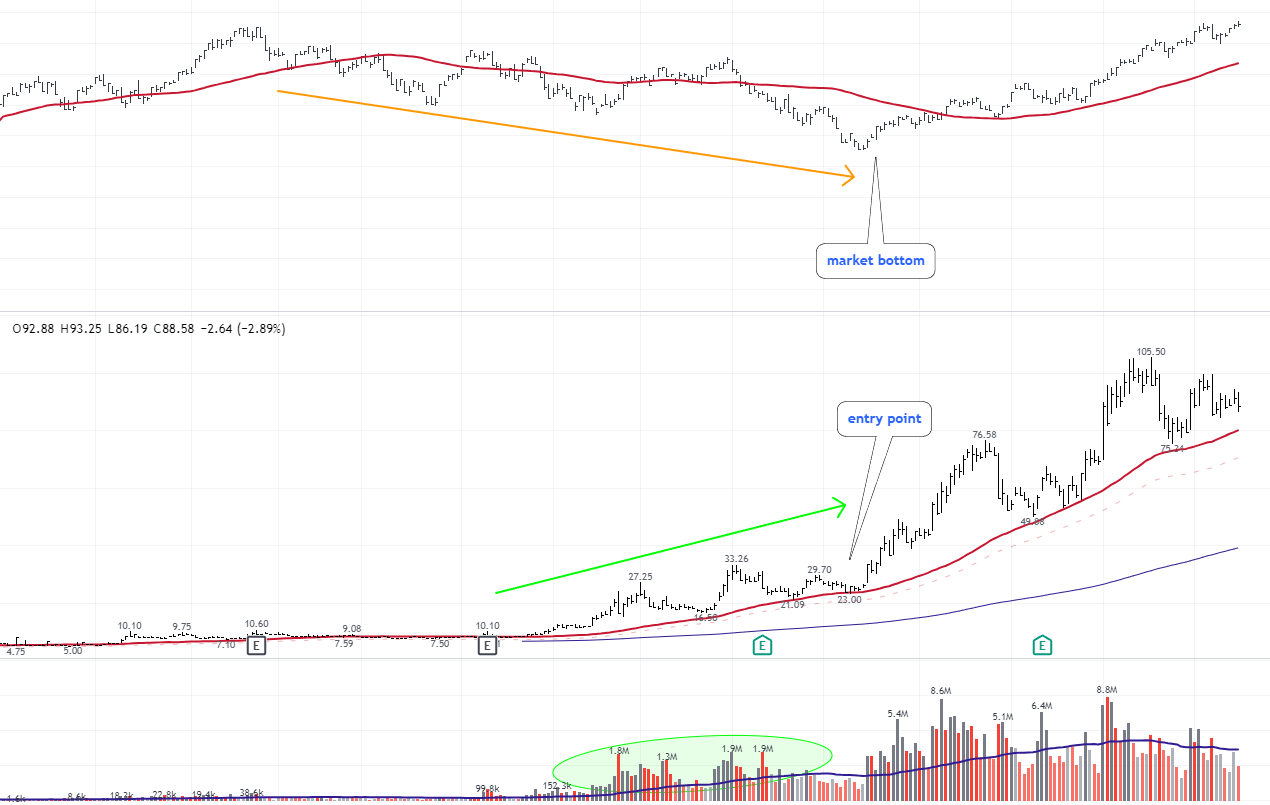
For example of relative strength, take a glance at TZOO in 2004 against the Nasdaq Composite (top):
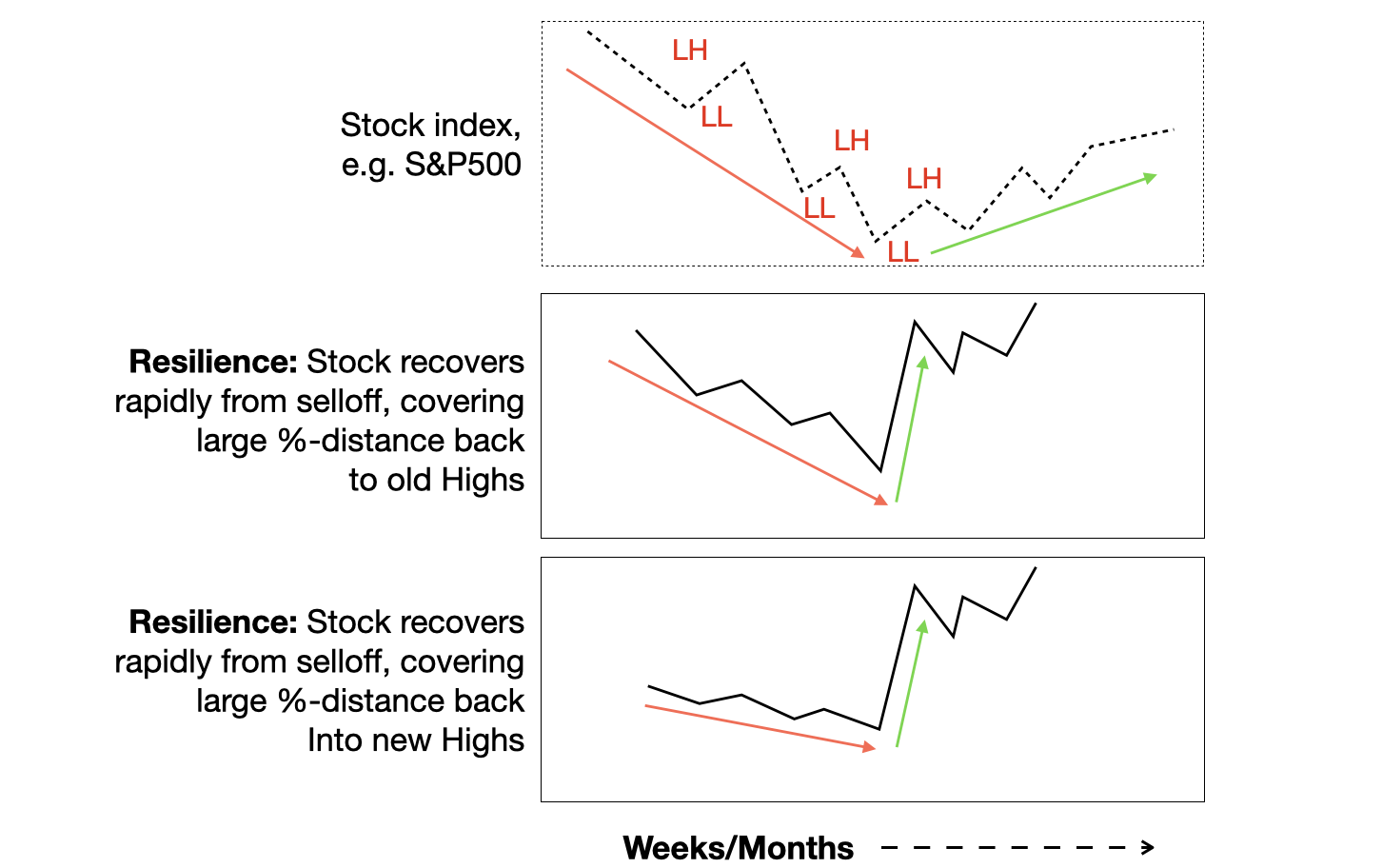
A stock shows resilience when it declines with the general market, but recovers rapidly back to old price highs once the selling fades, similar to a spring once the weight comes off:
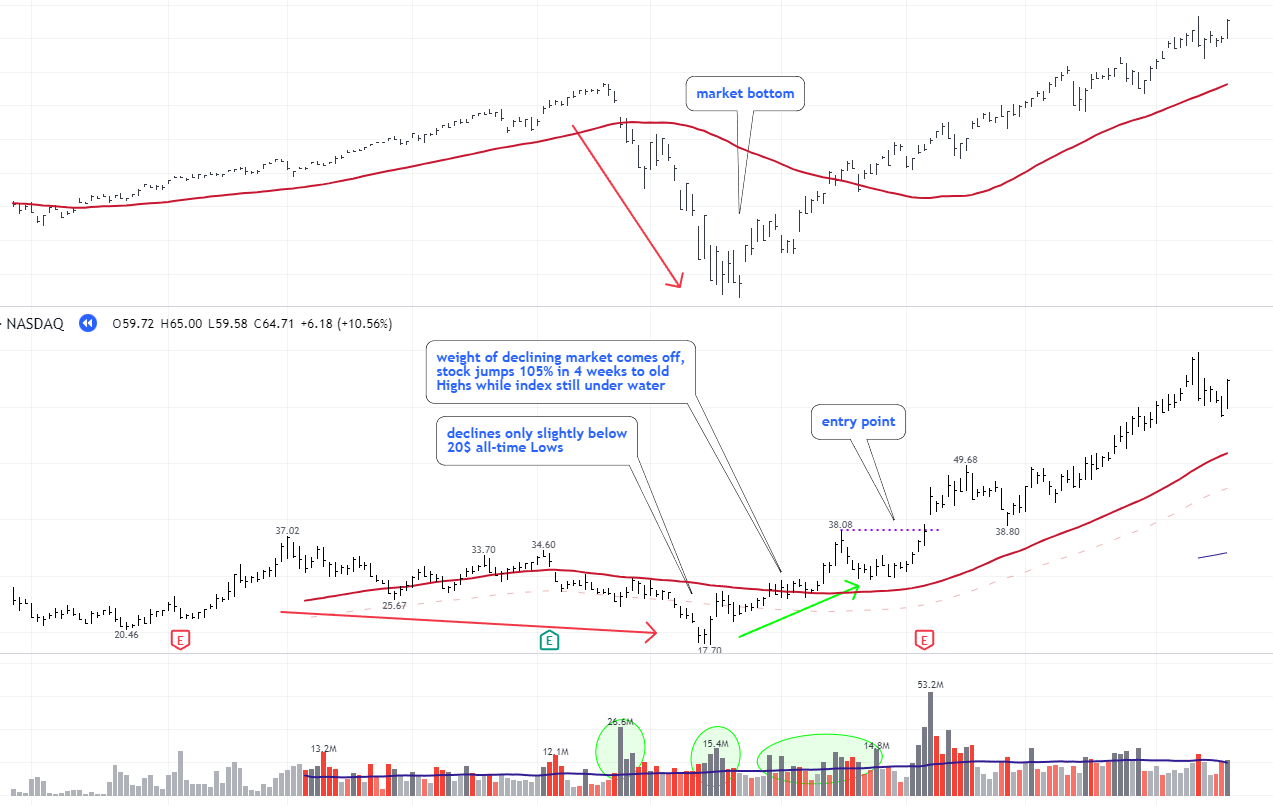
Check out how fast and far PTON recovered in 2020, while the NASDAQ Composite still floundered about far below its old peak:
While relative strength and resilience can point you in the right direction, they are far from perfect – there can and will be lots of false signals by them (especially in weaker, illiquid or even penny stocks) during fake bear market rallies or secondary corrections, they cannot guarantee that there will be group confirmation for your pet stock, and neither can they show you that any given stock will eventually work for you. They are merely tools you keep in your toolbox to help give you an indication of where a market might be going.
Overall, for some more conservative speculators, it is advisable to let a market prove itself to you first. This is also recommended after a lengthy period of choppy markets, prone to whipsaw and stop you out. You don’t have to jump on right the first opportunity you see. Wait for some confirmation to build conviction – in a true bull run, many stocks will pop up weeks, months and sometimes years after the bottom.
Take it easy – there will always be another opportunity. As Loeb says, any missed stock is nothing but “an inconsequential misadventure“.
So long,
TGS